
Read Livingston County's Owner-of-Record Card
The Livingston County Property Search blends Treasurer and Equalization data into one countywide working copy, with periodic updates supplied by local assessing units. Start a current-owner check with its exact Owner's Name field. Then read the surrounding fields, because they show whether that name actually belongs to the correct active parcel.
| Owner's Name | The party currently carried for assessment administration |
|---|---|
| Owner mailing address | Where correspondence goes; it need not be the property |
| Property or situs address | The assigned location of the land itself |
| Parcel status and number | The active/retired state and cross-system identifier |
| Sale or transfer detail | A card clue to compare with a recorded conveyance |
| Legal description | The bridge to the deed or plat for this land |
Keep one distinction in mind. The record names an owner of record, not an occupant. In the GIS schema, owner fields begin O_ while property fields begin P_. A mailing address far from the land can still be fully consistent with ownership. The official Livingston County assessor search form holds the answer. It shows the controls that lead to that record:
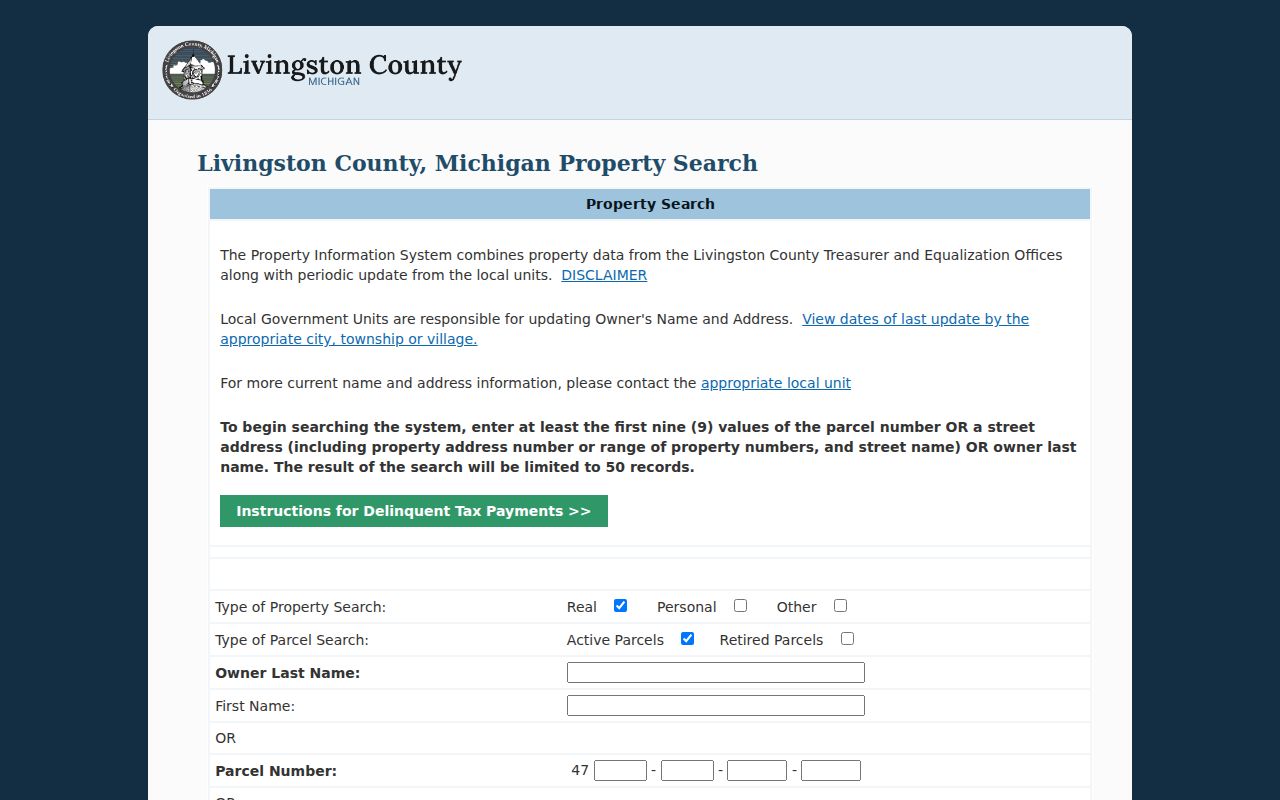
That page offers Real, Personal, and Other property choices plus Active and Retired status filters, along with owner, parcel, address or range, and municipality fields. It is a search form, not a sample owner result.
Verify Livingston's Current Owner Against the Newest Deed
The assessor card and the newest recorded conveyance should agree. Take the present administrative name from the roll. Then use the Livingston deed index to test whether a later instrument names a different grantee.
- Find the active parcel by address and save its number, Owner's Name, municipality, and available update date.
- Search that exact name as grantee in the deed index, then try supported spelling or entity-name variants.
- Compare the newest relevant deed's recording date, instrument or liber/page, and legal description with the parcel.
- If the grantee is an LLC, confirm the exact legal entity through Michigan's MiBusiness Registry; never substitute its registered agent for the landowner.
- Owner of record
- The party currently carried on the assessment roll.
- Grantee
- The party receiving the interest described by a deed.
- Recording lag
- The interval between a conveyance reaching the ROD and an assessment-roll refresh.
- Registered agent
- A statutory entity contact, not automatically the property owner.
Watch the dates. The roll can lag a recent sale. A matching recorded deed newer than the local-unit update may carry the more current owner signal.
Livingston Publishes No Single Owner-Update Lag
Cities, villages, and townships periodically refresh the county's shared property system, according to the county. It publishes no single fixed delay between a closing and an owner-name change. The countywide gap can vary. That gap matters. The local assessor maintains the card, while the Register of Deeds timestamps each recorded instrument. For a just-sold parcel, ask the correct assessing unit. Ask when its latest update reached the county copy. An unchanged name is not proof that a reported sale failed. Save the roll date, the deed recording date, and the date of your inquiry. Those three dates show exactly what each custodian displayed at the time.
Note: Livingston's periodic-refresh notice supports a date comparison, not a guessed number of days for every municipality.
Check Active and Retired Livingston Parcels
The county search covers both active and retired parcels. A split or combination can retire the identifier tied to an older sale. It also creates successor parcels with current records of their own. An address may return only an old card. In that case, find the land in the Interactive Parcel Viewer. Note the current outlines there, and search the resulting parcel IDs. This step prevents a serious current-owner error. That error is pasting the owner of a retired parent parcel onto one new lot without establishing parcel continuity. Expect the county search to use the county-number format beginning with 47. GIS, however, displays dashed segments without that prefix. Reconcile the format before rejecting a match.
Interpret an LLC, Trust, or Estate as the Current Owner
When the roll names a legal entity, trust, estate, or fiduciary, keep the wording exactly as written. The entity itself may be the present owner. MiBusiness Registry can clarify an LLC's legal name and filing context. But its registered agent is not automatically the owner. Trust details may stay private beyond the vesting language in the deed. An estate-related update may call for both the recorded instrument and Livingston Probate Court context. Pre-2004 probate cases may need a clerk request. Public internet court records generally supply an index rather than complete images. Probate explains authority; it never replaces the recorded land document itself.
Build a Date-Stamped Livingston Owner Check
| Evidence | Capture now | Reason |
|---|---|---|
| Assessment roll | Owner's Name, active parcel, local unit, update date | Shows the administrative record |
| GIS popup | Owner fields, situs fields, parcel ID, map date | Confirms land and mailing fields are separate |
| Latest deed entry | Grantee, recording date, instrument, legal clue | Tests whether the transfer is newer |
| Local assessor response | Card date and refresh status | Resolves a recent-sale gap without guessing |
This compact, date-stamped evidence packet beats copying a single name. It also makes a later recheck possible once a local update or parcel change reaches county systems.
Use Livingston Owner Information with Restraint
A public mailing address is an administrative contact clue, not proof of residence. Michigan's Address Confidentiality Program gives qualifying survivors a substitute address with mail forwarding, and lawful redactions can limit other public records. Report only the minimum a legitimate property question needs.
Lawful contact only. Use public owner information for legitimate transaction, boundary, estate, or ownership correspondence. Never use it to stalk, harass, threaten, or harm anyone.
For the broader address-to-owner method, see Who Owns This Property. To trace earlier grantees, use Former Property Owners; that historical chain stands apart from a present-owner check.