
Livingston Deed Records by Type
The Register of Deeds keeps the county's real-estate records. That office records each instrument and indexes it for public notice. A deed names the parties, describes the land, and states the interest conveyed. It also carries the recording reference. Mortgages and liens show up in the same index. Yet they usually secure a claim instead of transferring full ownership.
| Deed Type | What It Does | Common Use |
|---|---|---|
| Warranty deed | Conveys the stated interest with broad covenants from the grantor. | Ordinary arm's-length transfer |
| Quitclaim deed | Transfers only the interest the grantor may hold, without broad title promises. | Family, estate, or chain cleanup |
| Trustee or fiduciary deed | Transfers through a trust, estate, or other authorized representative. | Estate or trust administration |
| Sheriff or tax-related deed | May follow a completed foreclosure process. | Foreclosure transfer, subject to its record trail |
| Land contract memorandum | Records terms or notice of a land-contract interest. | Installment purchase evidence |
The county's document list is broad. Deeds sit beside mortgages, discharges, liens, foreclosures, land contracts, leases, restrictions, court orders, plats, condominium surveys, UCC records, and miscellaneous filings. Always read the document type first. A discharge only clears a prior mortgage, and a name on it is never proof of a transfer.
Search Livingston Deed Index Fields
The free Livingston deed index offers several routes to the same recorded instrument. Start with a few fields. Add more only as needed. Under the form's guidance, a document-type or government-unit search must travel with a recording date range, and because results cap at 150, an exact name, date, liber/page, or instrument number saves real effort.
| Index field | Input | Best use |
|---|---|---|
| Party name | Last or business name, first name, From or To role | Build a grantor-grantee chain and test name variants. |
| Document and date | Type plus recording date range | Separate deeds from mortgages, liens, and discharges. |
| Liber and page | Up to five and four digits | Open a known book reference. |
| Instrument number | Up to 15 characters | Retrieve one exact modern filing. |
| Unit or parcel | Government unit or segmented parcel | Use as a lead, since neither is required on every filing. |
A separate land-tract route handles legal-description work. The office FAQ still points to name searching, since discharges, court orders, and some liens carry no useful legal description.
View Livingston's Deed Search
The official grantor-grantee search form is the county's hub. Party roles, document details, date, liber/page, instrument, unit, and parcel controls all appear on its single screen.
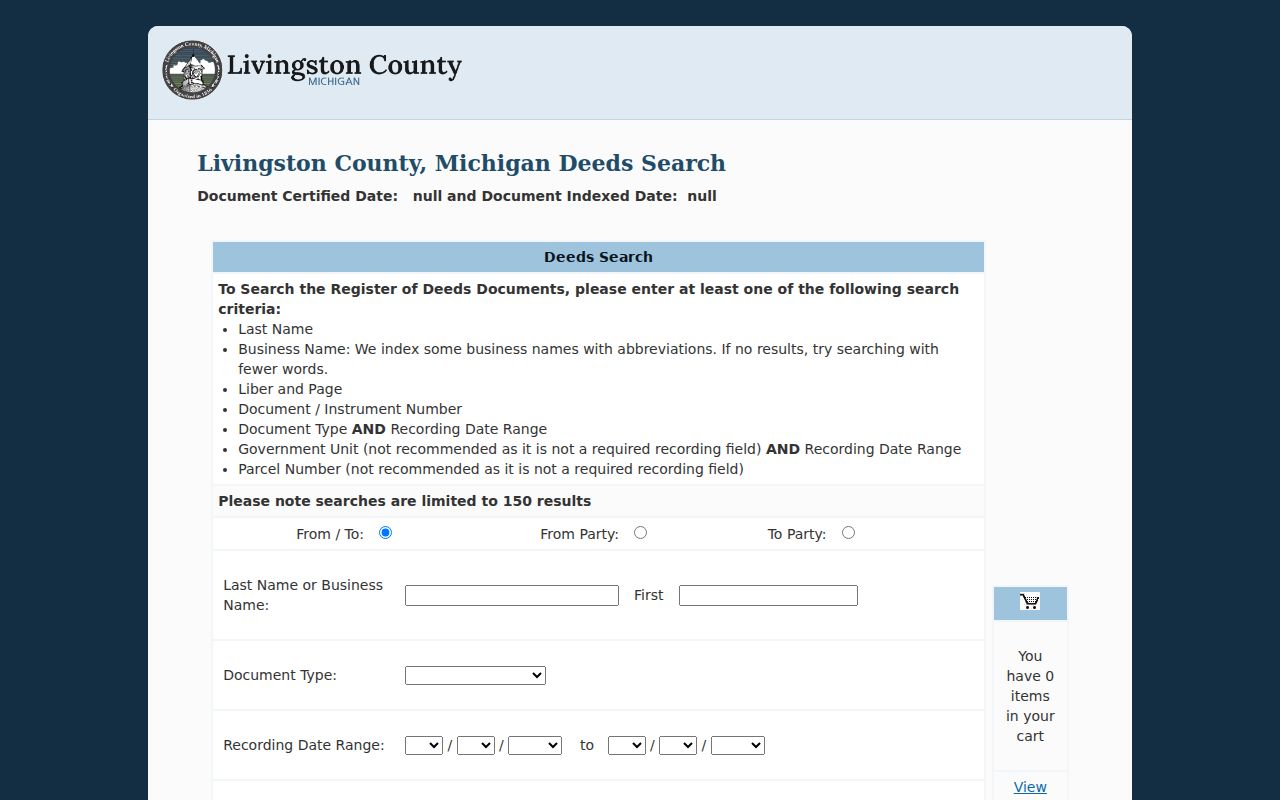
One lesson from the form is clear. A name-led search plus an exact recording locator beats reliance on optional parcel or government-unit fields, which many recorded instruments leave blank.
Walk Livingston's Grantor-Grantee Chain
The grantor transfers an interest. The grantee receives it. String those transfers together for the same land and you have the chain of title. Start with a current owner lead from the assessor. Then find the newest deed naming that owner as grantee, and match its legal description to the parcel before stepping further back.
- Search the latest owner as a grantee and open the most recent likely deed.
- Confirm the legal description, then record its grantor, date, deed type, and locator.
- Search that grantor as an earlier grantee and repeat the description check.
- Carry liber/page and instrument numbers forward to avoid the result cap.
- At the online boundary, continue through office indexes, books, and archival series.
- Grantor
- The party conveying the stated interest.
- Grantee
- The party receiving the stated interest.
- Chain of title
- The linked sequence of recorded conveyances affecting the same land.
- Liber/page and instrument number
- Two recording locators used to retrieve a specific document.
Cross Livingston's Online Boundary
Online Livingston County deed records run from February 1982, per the access page. The FAQ adds its own marker: indexed and imaged records reach back to November 7, 1980 or Liber 1000, and the work continues backward. The form itself offered year choices starting in 1980. Keep these statements distinct. One false cutoff hides real coverage.
Older material is already indexed in places. Libers 27 through 37 cover roughly March 1856 through November 1866. Where online coverage ends, the Register of Deeds tract index, office books, and microfilm fill the gap. Microfilm stays on hand as backup. The office's Black Books can surface wills or death-certificate leads for people who died outside Livingston County.
For older chains, the Archives of Michigan county guide points to tax, probate, township, and other series. Library of Michigan maps and plat books help too. Howell and Brighton collections and probate files can explain a name or parcel change. None of them substitutes for the deed books themselves.
Read Livingston Legal Descriptions
The legal description controls the recorded land. The Register of Deeds will not accept a street address, parcel ID, or tax legal as the recording description. Subdivision land may rely on lot, block, plat, condominium unit, or master-deed references. Older or rural land uses metes and bounds. Section, township and range, or government-lot terms appear too.
Consideration must also appear when transfer tax applies, unless an exemption allows otherwise. A stated figure is not market value. Not every dollar figure means a sale. Estate, related-party, nominal, and exempt transfers can make the number a poor price comparison. The recording rules cite the transfer-tax framework and MCL 565.201 for core execution and name requirements.
Use the instrument, not the shortcut. Match the complete legal description at each link; an address or tax parcel alone can connect the wrong land.
Livingston Deed Fees and Access
The Livingston County index itself costs nothing to search. Printed copies run $1 per page. Large plats and condominium drawings are $2 per page. Certification adds $5 on top of page charges. Online images are $1 per page plus a convenience fee. An emailed copy runs $2 for documents of one to ten pages, with stepped charges beyond that.
Other channels still work. Tapestry and Laredo both offer paid research access into the deed records. Certified online orders usually go out by mail within two to three business days after payment clears. A mail request needs a postage-paid self-addressed envelope for returning originals. Otherwise, include at least $3 in postage. Tract-index help is billed at $10 per hour unless the requester owns the property in question.
The Register of Deeds sits in the Historical Courthouse at 200 E. Grand River Avenue in Howell. Call 517-546-0270, Monday through Friday, 8:00 a.m. to 4:30 p.m. Swift can email back an eligible hard-copy deed. It must be recorded and indexed the same day.
Monitor New Livingston Filings
The Register of Deeds points property owners to Property Fraud Alert. It is a name-matching monitoring service. The service is separate from the county. When a document records against a monitored name, the service sends a notice. That gives you a reason to review a new filing early. It does not verify the parcel. It does not judge an instrument's validity or substitute for checking the deed index now and then.
Signup options can change, so confirm them with the live service directly. A common surname will trigger unrelated notices too. Match every alert against the county index and party roles. Also check the recording date, instrument number, and legal description.
Order a Livingston Deed Copy
Pin down the exact deed record in the index first. Record the party names, document type, recording date, liber/page or instrument number, and legal description. Then pick the copy type that fits the job. A plain image works for ordinary research. A certified copy carries the Register's certification. It is usually what a formal filing or transaction demands.
Call before ordering if an image is missing. Call too if the reference predates dependable online coverage, or if a large plat is involved. Give the office the precise locator and your return details for mail orders. Need the full ownership history instead of a single instrument? The backward-chain method appears in the county's former owners records.
Recorded is not guaranteed title. An index shows what reached the public record. It cannot rule out an unrecorded interest or replace a title opinion from a qualified professional.
Handle Livingston Chain Breaks
Many chains run cleanly from buyer to seller. Livingston County deed records can also turn through a trust, a probate estate, or a foreclosure. They can turn through a parcel split or a renamed entity. If the prior grantor never appears as an earlier grantee, try business-name variants, initials, spouse names, and fiduciary terms. Look for a court order, probate authority, land contract, or sheriff-related instrument sitting between two deeds.
Parcel changes can quietly break a name search. Compare full legal descriptions instead of insisting on the same tax ID in every era. A parent parcel may divide into children later. The Register cautions that parcel numbers are not mandatory recording fields. When party-name indexing leaves a gap, a tract search can follow the land itself.
Build one row per possible transfer. List the recording date, grantor, grantee, document type, liber/page or instrument number, legal description, and a confidence note. Never force a link when descriptions conflict. The Register's counter, tract index, microfilm, and older books are the right fallbacks before you declare an owner missing.
Verify Livingston Recording Details
The index points you to the document. The image supplies the actual terms. Confirm that the grantee and grantor names belong to one transaction. Check that the acknowledgment, execution date, and recording date do too. The consideration treatment and legal description should match as well. A deed may reserve an easement or except part of a parcel. It may also cite a prior plat or instrument. Those clauses can matter more than the index label does.
The county flags several common recording problems. An incomplete legal description appears on the list. So do a notary-venue mismatch and missing drafter information. Incomplete company or trust signer details, margin defects, missing original signatures, and name mismatch appear too. Such defects explain why a document gets returned or records later than the parties expected.
Constructive notice means a recorded instrument gives public legal notice under the recording system. Prima facie evidence means the record stands as evidence of its contents unless rebutted. Neither phrase guarantees that every private claim was recorded. Nor does it promise an error-free indexed chain. A high-stakes title conclusion therefore belongs with a qualified attorney or title professional.