
Livingston Tax Records by Field
Taxes follow the parcel, not the owner's memory. Livingston County property tax records tie each parcel's assessed and taxable values to the bill. That bill is issued for a given tax year. You can search Livingston County property tax records by address or by parcel number. The right custodian depends on the question. The local assessor keeps the assessment card and exemption status. Your city or township treasurer issues current summer and winter bills. The county Treasurer, meanwhile, handles delinquent real-property taxes and payment history. Keep the tax year, local unit, and payment status together. That prevents confusing a current bill with an older balance.
| Field | What It Shows | Where |
|---|---|---|
| Assessed value and SEV | Michigan's assessment measure, generally 50% of true cash value | Local assessor and Equalization |
| Taxable value | The capped or uncapped value used in the tax calculation | Assessment card and tax record |
| Exemption status | Principal residence, poverty, veteran, or other status when applicable | Local assessor |
| Current bill | Tax year, summer or winter installment, charges, and payment status | City or township treasurer |
| Delinquent history | Unpaid real-property tax, added amounts, clearance, and foreclosure route | Livingston County Treasurer |
Assessed value is not the bill, and it does not predict a sale. Because Michigan caps annual growth, taxable value can sit below SEV until the parcel transfers. After a transfer, taxable value generally uncaps to match SEV. The tax bill then applies millage rates to that taxable value. It also adds any status adjustments and charges.
Find a Livingston Tax Parcel
Every tax lookup in Livingston County starts with the Livingston County Property Search. It blends Treasurer and Equalization information with periodic updates from local assessing units. You can search real, personal, or other property. You can also filter by active or retired status. An owner name works to narrow things. A segmented parcel ID works too. An address plus local unit narrows the search further.
| Search control | Entry | Tax-record use |
|---|---|---|
| Owner | Last and first name | Find parcels when the tax ID is unknown. |
| Parcel | County code 47 plus four segments | Match assessment, tax history, and deed clearance work. |
| Address | Number or range, street, local unit | Locate a known property or part of a street. |
| Status | Active or retired | Trace a bill after a split or combination. |
| Property type | Real, Personal, Other | Avoid mixing land with another assessment class. |
Be aware of the 50-result cap. When a surname or road is broad, add the municipality or a tighter street range. Local units supply updates only periodically. If a recent transfer, exemption, split, or building change is missing from the county copy, contact that local assessor directly.
See Livingston's Tax Route
The official county property and tax landing page connects the parcel search to the paid tax-history path.
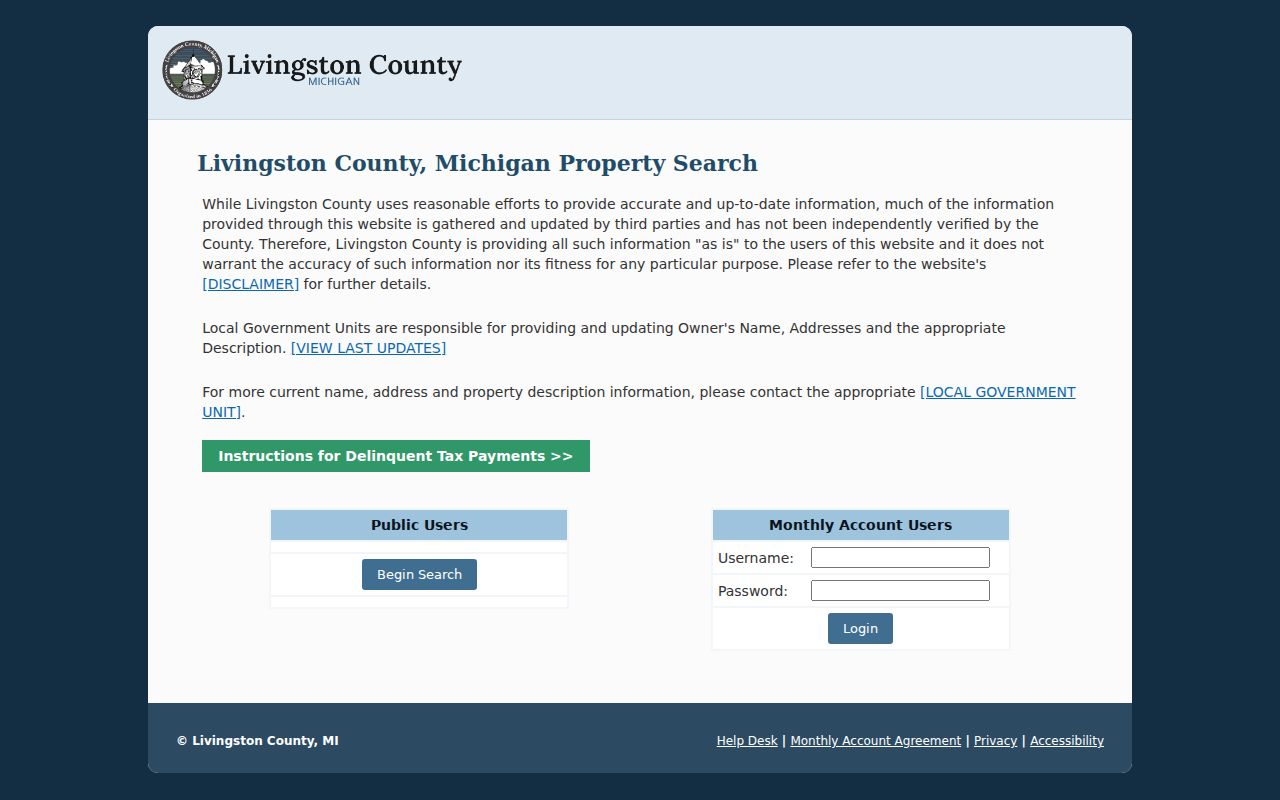
The page shows the route itself, not a parcel-specific bill. Confirm every amount, year, installment, and paid date on the live result.
Separate Livingston Tax Values
Michigan property records rely on several related values. True cash value means the usual selling price. Assessed value and state equalized value, or SEV, generally equal half of true cash value. This is the rule under the state framework. Taxable value is the figure the property tax is computed from. The annual cap holds it down until a transfer. A mill is one dollar of tax per thousand dollars of taxable value. The combined levy can involve several taxing units at once. A tax lien is the claim that arises from unpaid tax. Brighton's official assessing page posts principal residence, poverty, and veteran exemption materials. Eligibility and forms rest with the local assessor for the parcel. A deed's consideration and an assessor's value are different evidence. A transfer-tax affidavit, exempt transfer, related-party conveyance, or estate transaction may not yield an ordinary market sale comparison.
Look Up Livingston Tax Bills
Start with the parcel number and local unit. The current summer or winter bill belongs with the city or township treasurer. For delinquent real-property taxes, tax clearance for deeds, paid history, and forfeiture or foreclosure administration, the route is the Livingston County Treasurer. The State of Michigan serves as the foreclosing governmental unit for Livingston County.
- Search the county property portal by address, owner, or parcel and confirm the local unit.
- Open the local treasurer route for the current summer and winter bill.
- Preserve the tax year, installment, taxable value, millage, payment date, and source date.
- Check exemption and transfer status with the local assessing office.
- Use the county Treasurer for delinquent history, added amounts, or tax clearance.
- Assessed value
- The assessor's value measure, generally half of true cash value in Michigan.
- Mill rate or levy
- The tax rate applied to taxable value by the relevant taxing units.
- Principal residence exemption
- A Michigan tax status tied to a qualifying principal residence, subject to official rules.
- Tax lien
- A claim against property arising from unpaid property tax.
Order Livingston Tax History
The county tax-history route costs two dollars plus a fifty-cent convenience fee, which the Treasurer lists as $2.50 total. Tax history is not available by phone. Search the parcel first. Follow the paid history path only after confirming the parcel number and local unit. A solid history record preserves the tax year, each installment, taxable value, local levy context, any delinquency or interest, the paid date, and the date the source was consulted. The live record shows what it shows. Do not assume a bill field or payment status the record does not display. For a deed transaction, the county Treasurer also handles tax-clearance work. That service is distinct from the Register of Deeds' tax-certificate charge on certain instruments, and distinct again from a local treasurer's current bill.
Track Livingston Delinquent Taxes
Unpaid real-property tax moves out of local collection and into the county delinquency process. The Livingston County Treasurer delinquent-tax page routes payments and explains forfeiture and foreclosure steps. Always confirm the tax year and parcel before treating a balance as current.
Tax foreclosure and mortgage foreclosure are separate systems. The state tax process concerns unpaid property taxes. A sheriff sale may follow a mortgage case. A notice, scheduled sale, or delinquent line is not proof that ownership changed hands. Confirm any completed conveyance in the deed record.
Time matters. Delinquency amounts and legal status can change. Verify the live balance and process stage with the responsible treasurer before payment or purchase decisions.
Review Livingston Exemption Status
Exemptions start with the local assessor, not a county tax-history purchase. Brighton's assessing materials identify principal residence, poverty, and veteran exemptions. They also cover transfer and uncapping details. Howell describes its parcel card as covering owner and address. It also includes land and building facts, tax description, sale or transfer data, taxable status, and market-value information.
Confirm the form and dates locally. The assessor for the parcel's city or township sets filing conditions and deadlines. Livingston County publishes no single countywide appeal calendar or complete exemption-form inventory. That gap matters. A postal city does not decide assessment jurisdiction. Use the municipality field in the county property search. The GIS municipal boundary map works too.
Contest a Livingston Assessment
Begin with the local assessor. Keep the assessment notice. Check the parcel number, classification, land and improvement facts, exemption status, transfer history, and the assessment year. A factual error resolves differently from a value dispute. The local Board of Review is the first formal venue named in county and city materials, and qualifying valuation appeals then move to the Michigan Tax Tribunal.
Evidence matters. Bring the current card, photographs, a survey or plat when land facts are wrong, comparable sales, an appraisal, permit records, and a short table of each claimed correction. Equalization reports show trends and local-unit totals. They do not replace parcel-level proof. For value terms without the bill process, see the Livingston County property value record.
Confirm the live appeal calendar. Research did not locate one countywide filing deadline. Ask the local assessor for the current Board of Review dates, forms, and prerequisites before filing.
Read Livingston Tax Years Carefully
One parcel can carry several dates at once. Label each one. There is the assessment year, bill year, summer and winter installments, payment date, transfer date, and forfeiture stage. A paid prior-year entry does not prove the current year is paid, and a current local bill says nothing about an older amount in county collection.
Keep the local unit with every line. School district, municipality, and other taxing components shape the levy. The county Equalization report offers local-unit totals and assessed, equalized, and taxable-value trends. The card and bill govern one property. Values can change after a transfer. Review uncapping and assessment records before blaming a rate increase.
A defensible packet lists the full parcel ID, tax year, taxable value, installment, amount, payment status, exemption status, local unit, and source date. Portals omit items. Ask the custodian instead. Never fill the gap from a different tax year.
Route Livingston Tax Questions
Route each question to the right office. Questions about valuation, classification, parcel cards, exemptions, and transfer status go to the local assessor. Current bills go to the city or township treasurer. Delinquent real-property tax, county tax history, tax clearance, and forfeiture or foreclosure administration go to the Livingston County Treasurer, and this routing is the core of a sound property tax search.
The County Equalization Department assists local assessors, maintains legal-description support, and works toward uniform valuation. It cannot replace the assessing officer. The assessing officer keeps the current parcel card. Report data and local-unit comparison fit there. The Michigan Tax Tribunal hears qualifying valuation disputes after the required local steps.
Bring a parcel number and tax year. Add the address, owner name, local unit, and the precise field or payment at issue. Clear identifiers protect you. Staff otherwise may answer for a nearby parcel, an old parent parcel, or the wrong tax cycle.
Avoid Livingston Tax Record Traps
The biggest trap treats all values as one number. SEV, assessed value, taxable value, deed consideration, and likely sale price serve different uses. A second trap reads a scheduled foreclosure step as a finished ownership change. The deed index should confirm any later conveyance. A third trap relies on a postal city instead of the legal assessing unit.
Timing misleads too, since local units update the county property system on their own schedule and the county publishes no fixed lag. A recent sale, exemption filing, parcel split, or building change may surface first at the local office. Ask for the card's effective date. Keep the notice that prompted the question.
Tax history is not available by phone. The county offers a paid online route. Fees, interest, and legal stages change. For a live balance or payoff, use the responsible treasurer's instructions, since a saved result shows one date rather than a standing quote.