
Find Out Who Owns a Livingston County Property
Start with the land, not a guess about a person. Enter an address in the assessment search. It returns the parcel plus the owner-of-record name as the county holds it. The GIS viewer then confirms the tax parcel and municipality. From there, the newest indexed deed shows the most recent grantee recorded against that land. Each source answers a different slice of the ownership question. So keep the parcel number, dates, and spelling of the name together as you go.
- Enter the street address in Livingston County Property Search, choosing the correct city, village, or township.
- Record the active parcel number, exact Owner's Name label, situs address, mailing information, and displayed update date.
- Open the Livingston deed index; search that owner as a grantee and compare the newest relevant instrument's legal description.
- If an entity appears, identify its exact legal name through Michigan's MiBusiness Registry. Treat a trust or estate name as recorded vesting, not an invitation to infer a resident.
If the address returns no match, open the Interactive Parcel Viewer guide first and pin down the parcel and its municipal boundary. The county portal also searches retired parcels, a useful fallback after a split or combination.
The official Livingston County Property Search form makes that first step concrete:
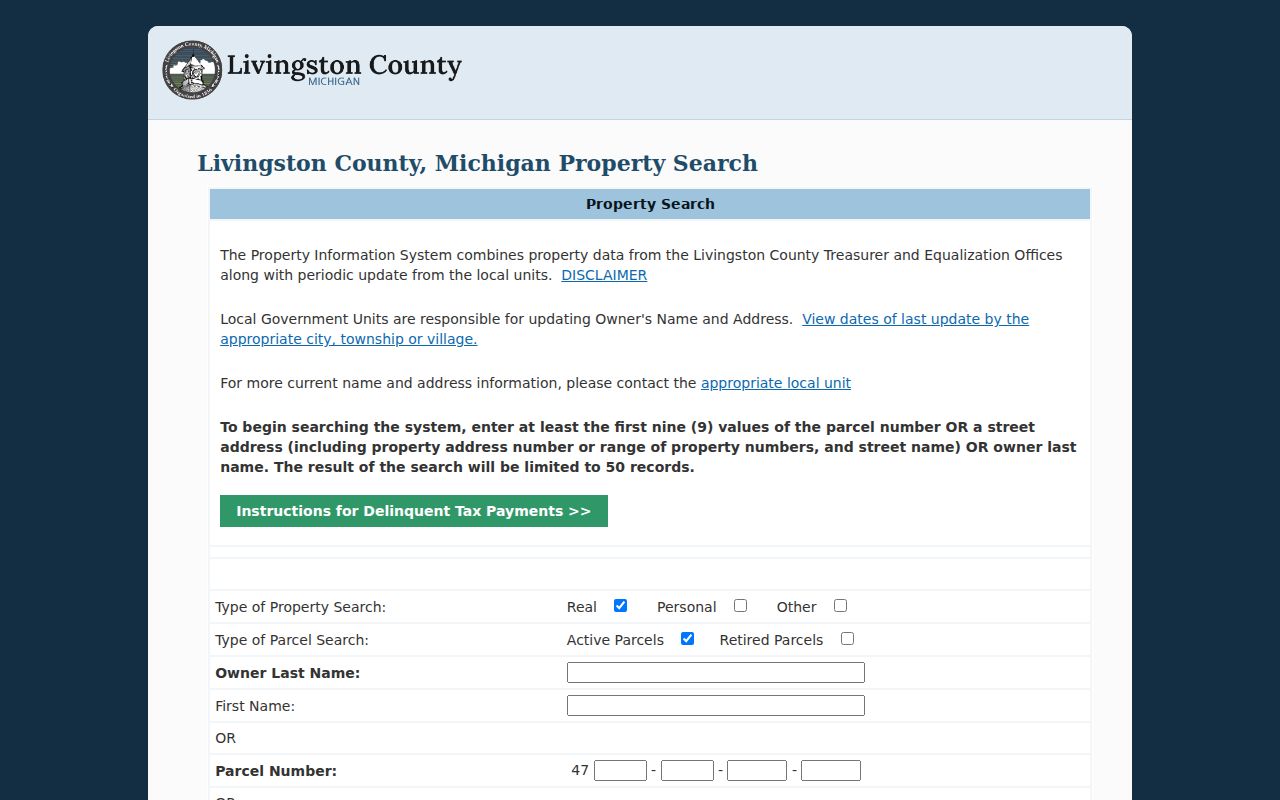
The official search form treats owner, address, parcel status, parcel segments, and municipality as separate controls. It displays no individual property record and implies nothing about any particular person.
Where Livingston County Records Show Ownership
No single Livingston County screen settles the whole ownership question. Use the assessment roll for the working current name, the deed index for recorded acquisition, and GIS for parcel geography.
| Source | Owner Info It Gives | Access |
|---|---|---|
| County assessment roll | Owner's Name, mailing and situs clues, parcel status | Free county search; periodic local-unit updates |
| Register of Deeds index | Grantee, grantor, recording date, instrument or liber/page | Index free; document images carry a charge |
| Interactive Parcel Viewer | Owner fields tied to the selected tax parcel | Free map; preserve the layer date |
| MiBusiness Registry | Legal entity filing and agent context | Public entity search; does not replace the deed |
The assessment record names the party used for tax administration, nothing more. It does not show who occupies the premises. An owner may receive mail at another address, and a parcel may sit in an LLC, a trust, an estate, or a fiduciary capacity rather than an individual name.
Read Livingston Owner and Address Fields Separately
The GIS parcel schema separates owner fields such as O_NAME1 and O_NAME2 from property-address fields. Those address fields carry a P_ prefix. That split explains many apparent mismatches. The situs pinpoints the land itself, while the mailing address simply routes correspondence. Neither a mailing address nor a familiar surname proves anyone lives there.
- Owner of record
- The name currently carried on the assessment roll.
- Grantee
- The party receiving the interest described in a recorded deed.
- Situs address
- The location assigned to the property itself.
- Mailing address
- The destination used for owner correspondence, which can be elsewhere.
Note: Copy names exactly, including a second owner line or fiduciary wording, then try reasonable variants in the deed index.
Confirm Who Owns It with the Latest Livingston Deed
Start with the assessor's owner name. Take it to the Register of Deeds form and search it as a grantee. Use the legal description or a known instrument reference to separate same-name hits. The deed index exposes From and To names, liber and page, and instrument number. It also shows document type, a recording-date range, government unit, and parcel-number fields. Government unit and parcel number are not required recording fields. So an empty parcel-number search never proves a deed is missing.
Compare the recording date and grantee against the roll's last update. A newer deed may explain why the assessor still lists the seller. For proof or interpretation of title, order the instrument itself. Then consult a qualified title professional or attorney. The public index is not a title opinion.
When Livingston Property Belongs to an LLC, Trust, or Estate
An entity name is an answer, not an error. Search an LLC's exact legal name in MiBusiness Registry to learn its public filing context. Never swap the deed grantee for an individual. The registry lists a registered agent, but that is not the owner of record. For a trust, copy the trustee and trust wording exactly as recorded. For an estate or fiduciary deed, probate records or a recorded personal-representative instrument may explain the capacity.
The Livingston Probate Court handles local probate matters. Pre-2004 cases may need a clerk request instead of an online result. Keep that evidence beside the land instrument, never in place of it.
A Sale Can Outrun the Livingston Assessment Roll
Local assessing units refresh the shared property system periodically, the county says, but no single countywide figure for the gap between closing and an owner-name update is published. Ask the city, village, or township assessor about current timing. Stated plainly, that uncertainty beats inventing a standard lag.
Recent-sale check. Compare the assessment update date with the newest deed's recording date. A newer recorded deed can be the more current ownership signal.
Check whether a result is active or retired. A land division can mint new identifiers while an older owner-name result stays searchable.
Use Livingston's Fraud Alert as Monitoring, Not Proof
The Register of Deeds links to Property Fraud Alert, a name-based monitoring service for later recording activity. An alert can prompt an owner to inspect an unexpected filing. Enrollment verifies nothing about current title. Silence certifies nothing either. Follow the current ROD and vendor instructions to enroll.
What a Livingston Ownership Lookup Cannot Establish
A public lookup can identify an assessment-roll owner and the grantee in a recorded deed. It cannot show who lives at an address. It cannot resolve unrecorded claims. It cannot decode every trust or probate interest, or settle a disputed boundary. Michigan's Address Confidentiality Program shields qualifying participants behind a substitute address. Lawful redactions may also limit what any record displays.
Lawful use. Use Livingston County owner information for legitimate property research, transaction due diligence, boundary questions, or estate work. Never use it to stalk, harass, threaten, or harm a person.
For present-owner detail, see Current Property Owner. Trace the historical chain through Former Property Owners, or turn to Deed Records for copies and mechanics.